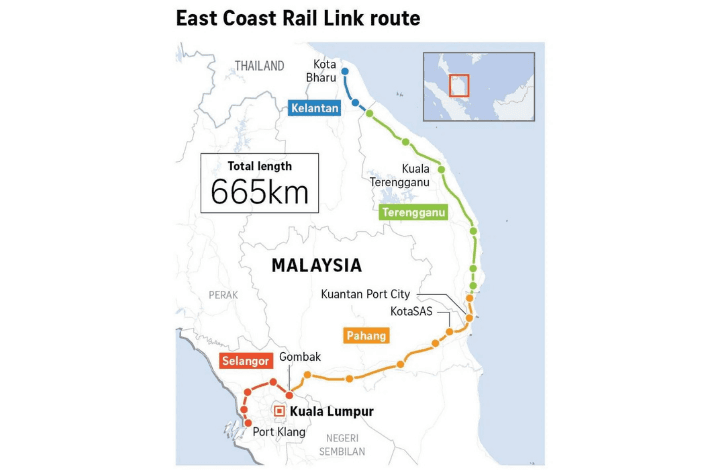

The line, which will connect Kuala Lumpur to key east coast cities including Kuantan, Kuala Terengganu and Kota Bharu, is now nearly 92 per cent complete, Transport Minister Anthony Loke said.
“In about 11 months, we will see the first train running from Gombak to Kota Bharu,” Loke said, describing the development as a major milestone for Malaysia’s transport system.
Preview Run in Pahang
The minister was speaking in Kuantan, Pahang’s capital, where the preview covered a 20km round trip between KotaSAS (Kota Sultan Ahmad Shah) and Kuantan Port City stations.
Also in attendance were Communications Minister Fahmi Fadzil and China’s Ambassador to Malaysia Ouyang Yuying.
The trial run featured the introduction of the Chinese-built CR200J passenger trainset, alongside electric locomotives designated for cargo services.
A Strategic National Project
Owned by Malaysia Rail Link (MRL), a subsidiary of the Minister of Finance (Incorporated), the ECRL carries a finalised cost of RM50.27 billion (S$16.2 billion). Launched in 2017 under China’s Belt and Road Initiative, construction is being undertaken by China Communications Construction Company, with financing from the Export-Import Bank of China.
Malaysia projects the railway will boost the national economy by 3.8 per cent over the next two decades, driven by improved cargo efficiency, faster passenger movement and industrial spillover effects.
A Break from the Past
The ECRL represents Malaysia’s first major new railway line since independence in 1957 and marks a departure from the 1,000mm narrow gauge used by national operator Keretapi Tanah Melayu (KTM).
Built on the wider 1,435mm standard gauge, the new system allows for coaches approximately 30cm wider than KTM’s Electric Train Service (ETS), accommodating five seats per row instead of four.
Fahmi, after touring the train interior, described the carriages as spacious and comfortable. Each seat is equipped with generous legroom and full-sized power sockets. A dining car has been incorporated into the trainset, although it was not operational during the preview.
Cutting Travel Time
For residents of Kelantan, Terengganu and Pahang, the ECRL promises a significant reduction in travel time. According to MRL, the journey between Gombak and Kota Bharu will take four hours and 45 minutes — compared with around six hours by road under normal conditions, and up to 12 hours during peak festive seasons.
The only existing rail link between Kuala Lumpur and the east coast follows KTM’s century-old eastern line, which requires passengers to detour south to Gemas before heading north-east — a route popularly dubbed the “jungle train” due to its forested interior alignment. Coastal cities such as Kuantan, Kemaman and Kuala Terengganu currently lack direct rail access.
The ECRL aims to fill that gap.
Freight and Regional Connectivity
The passenger service will be supported by 11 trainsets, while cargo operations will deploy 12 electric locomotives.
Beyond passenger convenience, the railway is positioned as a strategic “land bridge” connecting Kuantan Port on the South China Sea to Port Klang along the Strait of Malacca. Plans are also in place to link the Kelantan stretch of the ECRL to the wider Trans-Asian Railway network via Thailand.
“ECRL has the potential to strengthen Malaysia’s position as a regional logistics hub,” Loke said.
For Kuantan-based restaurant owner Hazri Mokhtar, seeing trains glide along newly built elevated tracks signals tangible progress after years of political uncertainty and cost revisions following a 2018 government change.
“To see the rails being constructed was one thing, but watching the trains run is truly exciting,” he said.
With construction nearing completion and test runs underway, the long-debated megaproject now appears firmly on course for its long-anticipated launch.


