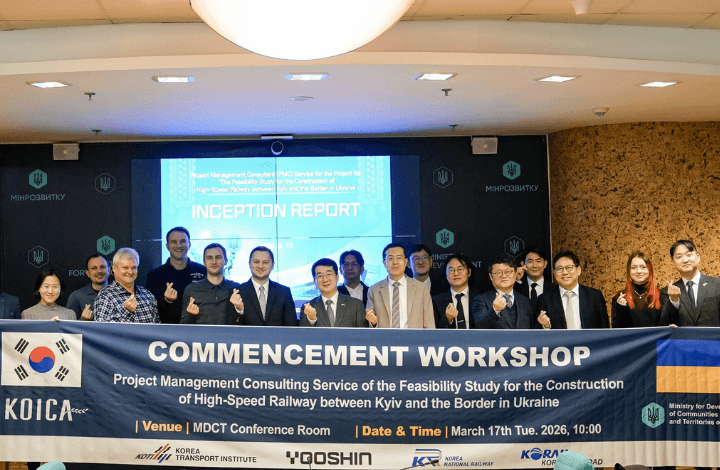

The discussions took place at Ukraine’s Ministry for Communities and Territories Development, involving Deputy Minister Oleksii Balesta, representatives from Ukrzaliznytsia, and a South Korean delegation comprising transport experts, officials from the Korea International Cooperation Agency (KOICA), and Ambassador Keechang Park.
The proposed project will assess the development of a high-speed passenger rail corridor as part of Ukraine’s broader efforts to modernise its railway system, support post-war reconstruction, and strengthen integration with the European Union’s transport network.
Balesta подчеркнул that while Ukraine’s rail system has demonstrated resilience during wartime, long-term planning remains essential. He described the high-speed rail initiative as a strategic investment in the country’s recovery and future development, positioning it as a key element in enhancing connectivity and aligning with European transport standards.
The feasibility study, funded through an $8 million grant from the South Korean government, will evaluate technical, economic and operational aspects of the proposed railway, including alignment with the Trans-European Transport Network (TEN-T).
Both sides reaffirmed their commitment to close collaboration, with discussions focusing on next steps for appointing consultants and advancing the study.
The initiative reflects a growing partnership between Ukraine and South Korea in infrastructure development, with the high-speed rail project expected to play a pivotal role in the country’s long-term transport transformation and regional integration.


