Přerov, June 2026 — Combined transport terminals sit at the centre of Europe's strategy to consolidate freight on rail, and the renewal of the Přerov site reflects how state-owned operators are reinforcing the physical backbone of that policy. The Czech facility functions as a distribution hub for Central Moravia and has been progressively integrated into wider Eurasian and Adriatic intermodal corridors feeding markets across continental Europe.
The modernisation, completed after roughly 16 months of construction, expanded the terminal by approximately 17,100 square metres, lifting its total area to around 36,000 square metres and almost doubling its previous footprint. Handling and storage zones have been reconfigured and track access improved, enabling the facility to support around 3,000 TEU of containers and semi-trailers. [5] The project was carried out together with Rail Cargo Operator–CSKD and EUROVIA CZ a.s., and has been co-financed by the European Union as part of its modal-shift programme.
For rail stakeholders, the upgrade unlocks higher train frequencies, more efficient handling of swap bodies and semi-trailers, and additional capacity to absorb growing intermodal volumes. The terminal is already embedded in Euro-Asian rail freight flows routed via Budapest, and the operator is positioning the site to support planned connections to the Adriatic ports of Koper in Slovenia and Rijeka in Croatia, broadening the North Sea–Adriatic corridor options for Central European shippers.
Board member Christoph Grasl framed the site as a cornerstone of the group's combined transport strategy, emphasising that resilient terminals offer customers continuity through volatile global supply chains. The EU-backed funding model also illustrates how public money is being channelled into private-sector freight assets to accelerate decarbonisation, with rail-bound container handling expected to deliver measurable reductions in CO₂ output and traffic on parallel road corridors.
Coming amid a wider wave of terminal expansions across the Rhine-Danube and Baltic-Adriatic corridors, the Přerov redevelopment signals how national champions like ÖBB Rail Cargo Group are aligning infrastructure investment with Europe's long-term modal-shift ambitions and the competitive pressures of cross-border intermodal logistics.
Source: Railway Pro
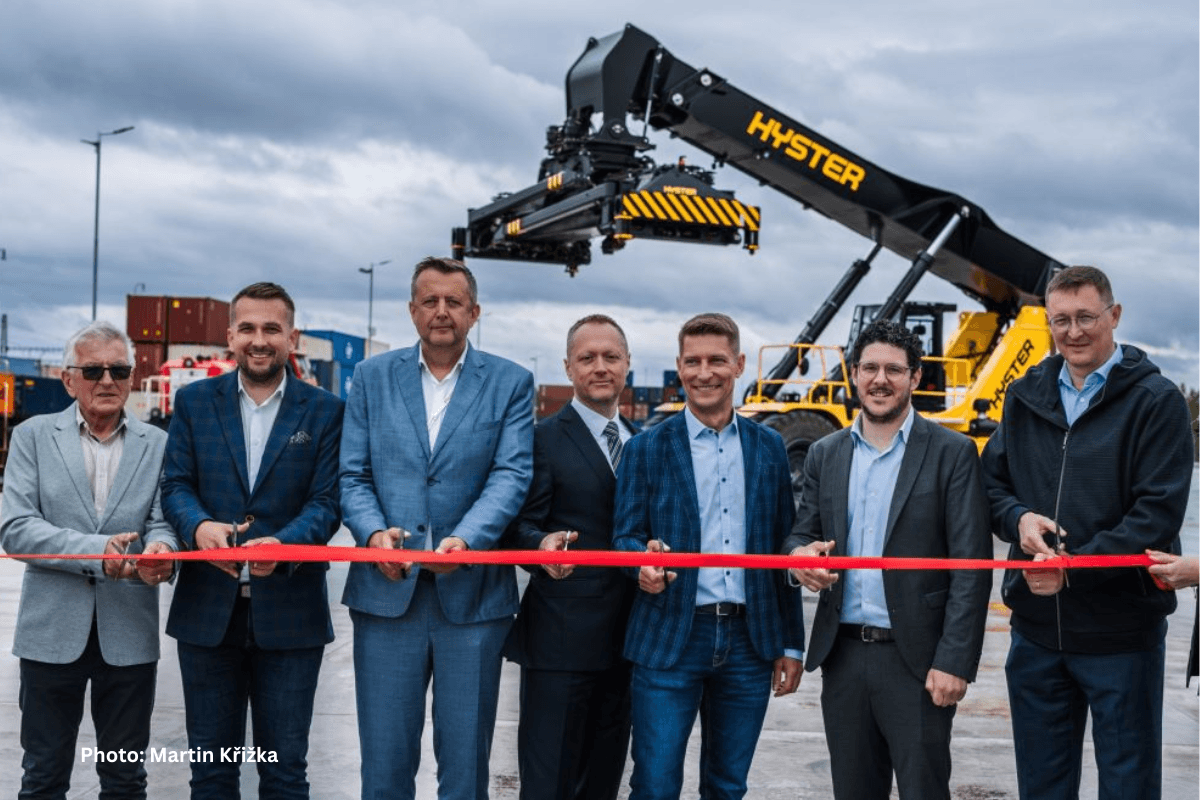
ÖBB Rail Cargo Group Doubles Přerov Terminal to Anchor Central European Combined Transport Network

Engineering Business Management
Share this story
European rail freight operators continue to expand intermodal capacity as the EU intensifies efforts to shift freight from road to rail and cut transport emissions. ÖBB Rail Cargo Group has reopened its expanded Přerov-Horní Moštěnice terminal in the Czech Republic after a 16-month modernisation that nearly doubled the site's footprint.


