Almaty, March 2026 - Swiss engineering and transport companies are assessing cooperation opportunities with Kazakhstan’s transport and logistics sector, according to Switzerland’s State Secretariat for Economic Affairs (SECO). Discussions focus on railway rolling stock supply, maintenance capability development, and logistics infrastructure linked to the Trans-Caspian International Transport Route across Kazakhstan, a corridor handling increasing Eurasian freight flows and requiring additional rail capacity and asset modernisation.
Swiss companies are evaluating potential participation in rail-sector development programmes led by Kazakhstan Temir Zholy (KTZ), the national operator. Areas under discussion include rolling stock procurement, lifecycle maintenance capability, and industrial partnerships for rail technology transfer. Cooperation could also support the development of maintenance depots, traction systems, and logistics terminals serving international freight corridors.
Kazakhstan operates one of Central Asia’s largest rail systems, with a network of more than 16,000 km of track and a fleet of approximately 1,700 locomotives and more than 44,000 freight wagons. The network carries most of the country’s inland freight movements and forms the core infrastructure supporting Eurasian transit services between China, Central Asia, and Europe.
Freight traffic on the KTZ network reached 287.8 million tonnes in 2025, while container transit volumes exceeded 1.39 million TEU, reflecting sustained growth in intercontinental rail freight along the Middle Corridor. Increased demand for cross-border logistics has intensified requirements for corridor capacity, wagon availability, and terminal throughput.
Rail infrastructure across Kazakhstan forms the backbone of the Trans-Caspian International Transport Route (TITR), linking the Chinese border to Caspian Sea ports through more than 3,500 km of strategic freight corridors. Ongoing infrastructure programmes include track renewal, axle-load upgrades, signalling modernisation, and capacity expansion to support higher train frequencies and heavier freight operations.
Kazakhstan’s railway modernisation strategy includes plans to construct 5,000 km of new lines and rehabilitate 11,000 km of existing track by 2029, alongside investment in freight terminals and intermodal logistics infrastructure. These upgrades are intended to increase corridor capacity and improve operational reliability across international transit routes.
Delivery risk remains linked to infrastructure condition and capital funding requirements, with a significant proportion of legacy track assets requiring renewal to maintain line capacity and freight throughput performance.
Strategically, potential Swiss participation in rolling stock engineering, maintenance systems, and rail logistics technologies could strengthen industrial capability within Kazakhstan’s railway sector while supporting the expansion of the Middle Corridor as an alternative Eurasian freight route.
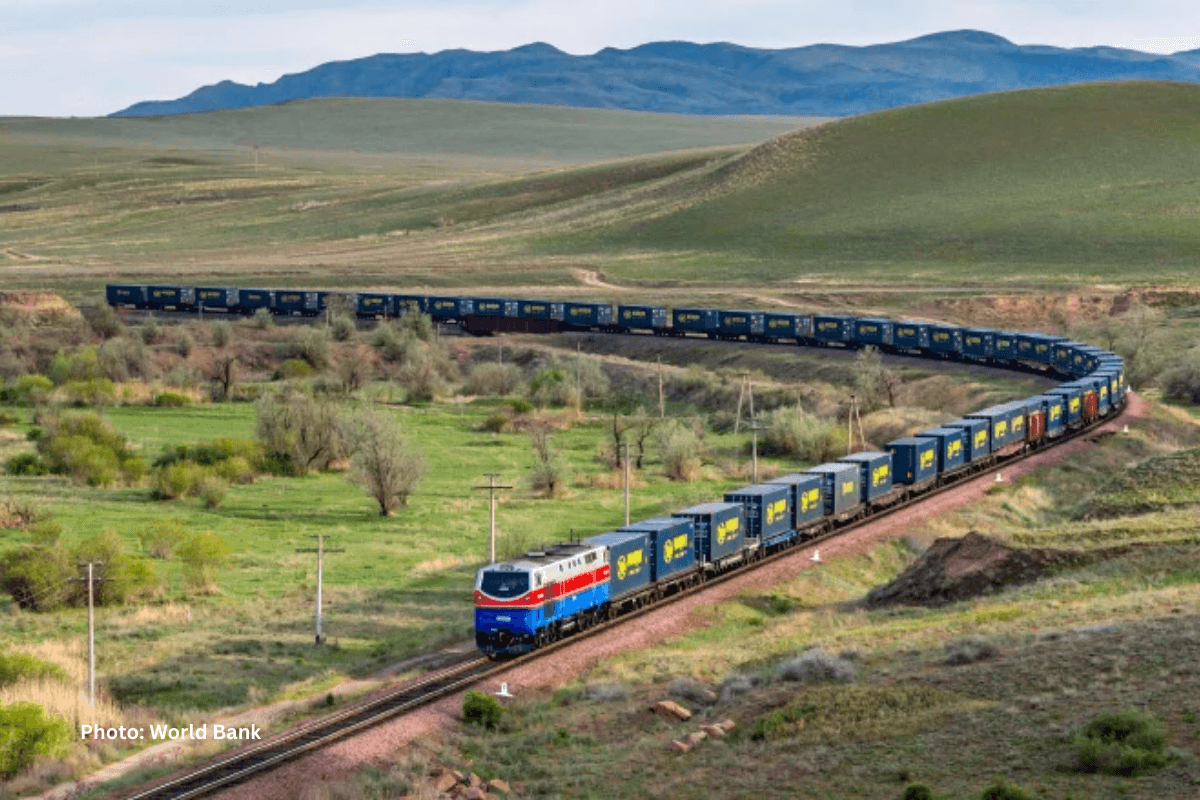
Swiss Firms Assess Transport and Rail Logistics Cooperation Opportunities in Kazakhstan

Engineering Business Management
Share this story
Swiss companies are assessing cooperation opportunities with Kazakhstan’s rail and logistics sector, according to Switzerland’s State Secretariat for Economic Affairs (SECO). Discussions focus on rolling stock supply, maintenance engineering and logistics infrastructure linked to Kazakhstan’s 16,000 km railway network and the Trans-Caspian International Transport Route, where container transit has exceeded 1.39 million TEU annually, increasing pressure on corridor capacity.


