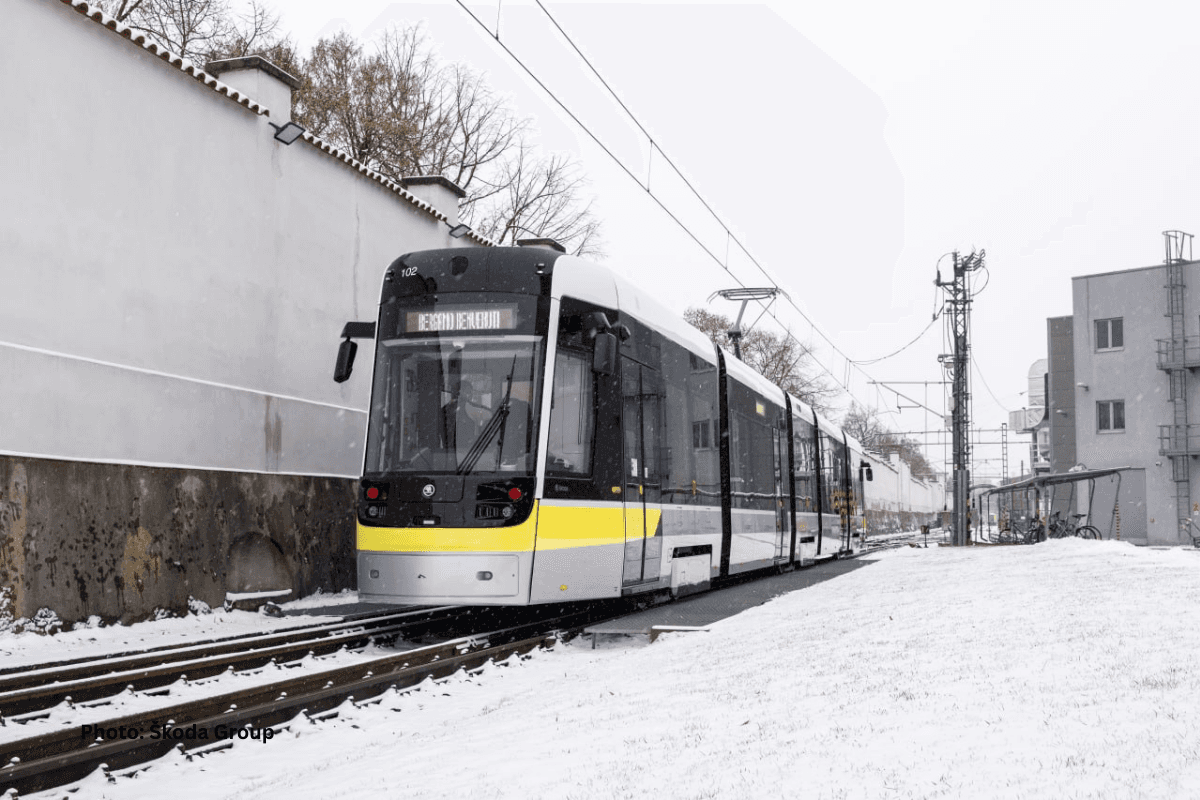
Bergamo, Italy, February 2026 - A newly built light-rail vehicle has rolled out from Škoda Group’s production line, marking a significant milestone in the northern Italian city’s expansion of its tram network and its broader transition toward rail-based urban mobility.
The tram will operate on Bergamo’s upcoming T2 line, an 11.5-kilometer corridor that will link Bergamo railway station with Villa d’Almè. This project is part of a larger effort by local authorities to strengthen public transport capacity while promoting sustainable urban development. Much of the route follows a former railway alignment, allowing for the introduction of rail transit with limited land acquisition and reduced construction impact.
The vehicle is a 33-meter, five-section bidirectional tram from Škoda Group’s ForCity Classic platform. Designed to operate from either end, it eliminates the need for turning loops at terminal stations, thereby improving operational flexibility. Each unit can accommodate up to 281 passengers and features a fully low-floor interior, enabling level boarding from platforms for wheelchair users, parents with strollers, and passengers carrying luggage.
Accessibility and passenger flow were central to the design. The tram is equipped with multiple wide double doors on both sides, allowing for rapid boarding and reducing station dwell times. Inside, the air-conditioned cabin includes dedicated spaces for wheelchairs, bicycles, and prams, along with modern LED lighting and real-time passenger information displays.
Safety technology is a notable addition. The Bergamo fleet will be the first Škoda trams equipped with an active anti-collision monitoring system that scans the track ahead and warns drivers of obstacles. This system aims to reduce accident risk in mixed urban environments where trams share space with pedestrians, cyclists, and road traffic. Operators expect the feature to improve reliability and enable smoother operations, particularly in densely populated areas.
The tram has a maximum operating speed of approximately 70 km/h, allowing it to serve both urban areas within the city and suburban areas along the outer sections of the route. By combining these roles, the T2 line is designed to operate as a surface regional rail link rather than a conventional street tramway.
This delivery is part of a contract valued at roughly €176 million, which includes infrastructure works, vehicles, and maintenance services. A total of ten trams will be supplied for the line.
Bergamo already operates the T1 tramway, and the network expansion aims to create a higher-capacity alternative to road-based transport. City planners view the tram as more than just a transport mode; fixed rail corridors are expected to stimulate development, encourage public transport use, and support transit-oriented housing and commercial growth along the alignment.
Across Europe, medium-sized cities are increasingly adopting modern tramways as a cost-effective alternative to metro systems, which are often financially impractical outside major metropolitan areas. The Bergamo project reflects this trend, positioning light rail as a middle-capacity solution that offers higher reliability and passenger comfort than bus services while avoiding the high capital costs associated with underground rail.
The arrival of the first vehicle signals the transition from construction to operations planning. Testing and commissioning will occur prior to the opening of the T2 line, after which Bergamo aims to operate an integrated surface rail network connecting urban neighborhoods and surrounding municipalities.
Bergamo Unveils New Generation Tram as City Expands Light-Rail Network

Engineering Business Management
Share this story
Bergamo is preparing to expand its public transport network with the arrival of a new-generation tram from Škoda Group, a vehicle designed not only to carry passengers but to anchor a wider shift toward higher-capacity, rail-based mobility.


