XIONG'AN, May 2026 — China’s Xiong’an Railway Station has gained renewed international attention after billionaire entrepreneur Elon Musk highlighted the scale of the facility on social media. The station, located in the Xiong’an New Area south of Beijing, is regarded as one of the country’s largest and most technologically advanced rail hubs.
The station reportedly spans an area equivalent to around 170 football fields and serves as a major interchange within China’s high-speed rail network. Designed to accommodate large passenger volumes and future urban expansion, the hub integrates multiple rail services while supporting the development of the Xiong’an New Area, a state-backed economic and innovation zone intended to relieve pressure on Beijing. (vnexpress.net)
The facility forms part of China’s broader strategy of linking newly planned urban centres through high-capacity rail infrastructure. Xiong’an Railway Station connects to several major high-speed rail corridors, enabling faster travel between Beijing, Hebei province, and surrounding economic regions. The station also incorporates advanced digital management systems, large-scale passenger handling infrastructure, and multimodal transport integration. (vnexpress.net)
The Xiong’an development has frequently been presented by Chinese authorities as a model for future smart-city planning, combining infrastructure-led growth with sustainability and technological integration. Rail connectivity plays a central role in the strategy, with high-speed transport designed to support decentralisation of economic activity away from heavily congested metropolitan areas.
International interest in the station also highlights growing global attention toward China’s rail engineering capabilities and infrastructure scale. Over the past two decades, the country has developed the world’s largest high-speed rail network, using major station developments not only as transport assets but also as catalysts for urban expansion and regional economic integration.
More broadly, the prominence of projects such as Xiong’an Railway Station reflects how rail infrastructure is increasingly intertwined with long-term national planning objectives. Large transport hubs are evolving beyond transit functions into integrated urban platforms that support economic development, digital systems deployment, and regional mobility transformation.
Source: VnExpress International
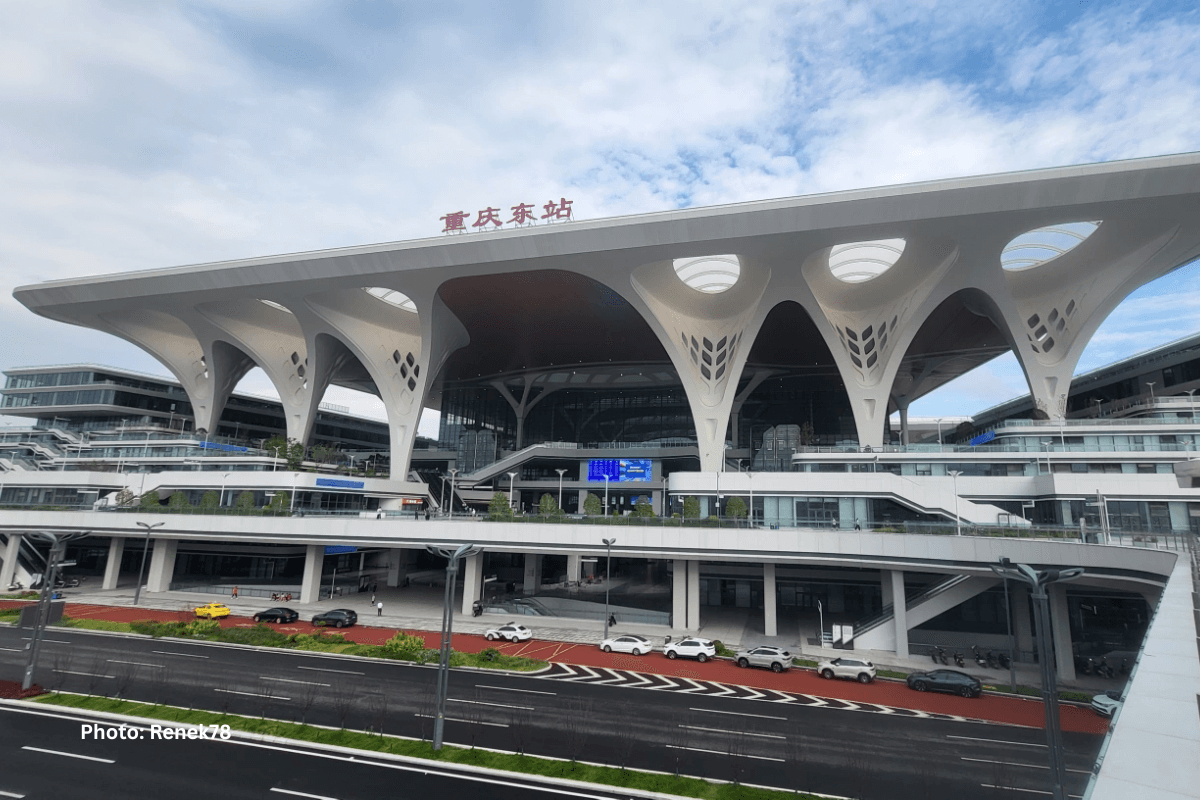
China’s Xiong’an Rail Hub Highlights Scale of Next-Generation Transport Infrastructure

Engineering Business Management
Share this story
China continues to position large-scale rail infrastructure as a central component of its long-term urban and economic development strategy. A massive railway station in Xiong’an, recently highlighted by Elon Musk, has drawn international attention for its scale and integration within China’s expanding high-speed rail network. The project reflects broader investment in transit-oriented urban development and future mobility systems.