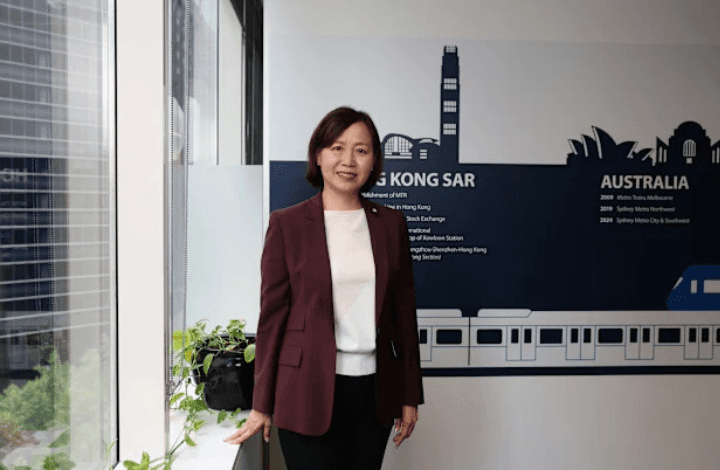
The company’s newly appointed chief executive, Jeny Yeung, who assumed the role on January 1, said MTR is keen to replicate in Australia the “rail plus property” model that has underpinned Hong Kong’s transport expansion for decades.
“In Hong Kong, we develop communities alongside railway infrastructure, and the value created from those developments helps fund the railway,” Yeung said during a visit to Sydney, where she met officials from the Minns government.
She declined to comment on the ongoing auction process for the Parramatta metro station site.
Parramatta in Focus
MTR, which operates around 271km of metro lines in Hong Kong and runs Sydney Metro’s existing services as well as Melbourne’s metropolitan rail network, is part of one of two consortiums shortlisted to develop the new Parramatta station.
The station will form part of the Sydney Metro West line currently under construction. The New South Wales government plans to transform the surrounding precinct into a mixed-use hub featuring housing, offices, retail outlets, restaurants, community facilities and parking.
MTR’s consortium includes Malaysian engineering group Gamuda Berhad and is competing against local developer Lendlease, which is already delivering a commercial tower above the new Hunter Street station.
Funding Rail Through Property
In Hong Kong, where the government owns roughly 75 per cent of MTR, the company secures development rights for land above and around new stations. It then partners with private developers to build residential and commercial projects, sharing in the profits.
One of its flagship projects is Lohas Park, a master-planned community built alongside a metro extension, comprising dozens of residential towers, a shopping mall and educational facilities.
For the six months ended June 30, MTR reported a HK$7.7 billion (US$1.4 billion) profit, a 27 per cent increase year-on-year.
Yeung said integrating rail operations with property development reduces fragmentation and improves coordination. “When the operator is also involved in developing the precinct, there is better overall integration and fewer risks of misalignment,” she noted.
Investing in Artificial Intelligence
Beyond property, MTR is ramping up investment in artificial intelligence to enhance operations and customer service.
In Hong Kong, the company has introduced a virtual assistant named Tracy, capable of speaking Mandarin, Cantonese and English. Installed at nine stations, Tracy handles routine passenger inquiries via interactive screens.
According to Yeung, the AI assistant has cut repetitive customer questions directed at human staff by more than a third. The system is also being upgraded to address ticketing issues, such as failed entry or exit taps, by scanning tickets placed beneath the display.
Australia a Key Growth Market
Australia, alongside mainland China and Southeast Asia, forms a core pillar of MTR’s international strategy. The company previously operated London’s Elizabeth Line and Stockholm’s metro system, though those contracts have since concluded.
Addressing concerns over geopolitical tensions and China’s influence in Hong Kong, Yeung stressed that MTR operates under an independent board of directors chaired by former chief executive Jacob Kam Chak-pui and adheres to strict corporate governance standards.
As Sydney pushes ahead with major rail expansion projects, MTR’s ambitions suggest that competition to shape the city’s transport-linked property landscape is set to intensify.