Maintenance works on the newly commissioned Pamban rail bridge in Tamil Nadu have temporarily disrupted electric train operations on the Mandapam–Rameswaram section, underscoring the operational complexities of electrified rail infrastructure in a high-salinity marine environment. Overhead equipment (OHE) is undergoing desalination to remove salt deposits accumulated from sea spray, with services suspended for approximately three days to stabilise traction performance and prevent flashover risks.
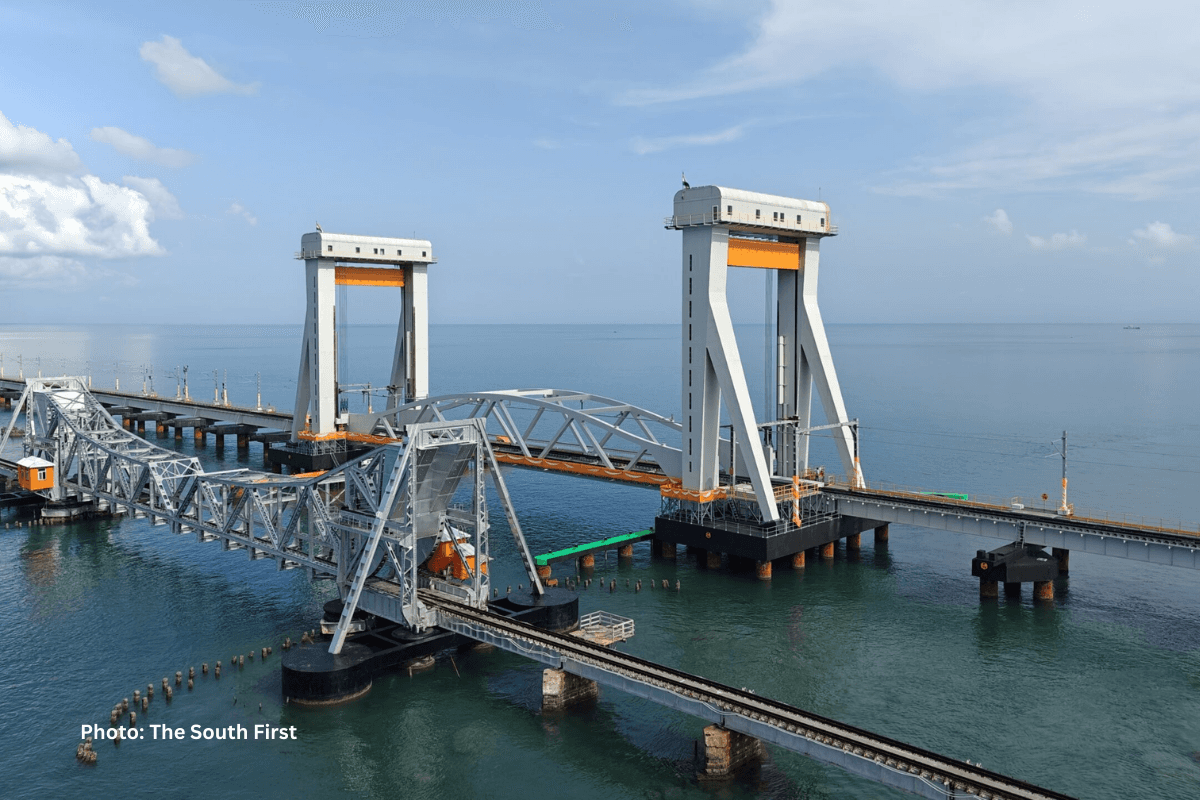
The new Pamban Bridge spans approximately 2.07 km across the Palk Strait, replacing the 1914-era bascule structure that was permanently closed in December 2022 due to structural deterioration. Designed to Indian broad gauge (1,676 mm) standards, the bridge comprises 99 approach spans and a 72.5 m central vertical lift span. The navigational span can be raised by roughly 17 m to permit maritime traffic clearance. The structure is engineered for train speeds of up to 80 km/h, representing a significant operational upgrade over the restrictive speed limits imposed on the old bridge.
Construction commenced in 2019, with structural completion achieved in 2024 and formal inauguration in April 2025. Total project cost has been reported between ₹531 crore and ₹645 crore (approximately USD 64–78 million). The bridge is designed for 25 kV AC electrification and includes provisions for future double tracking. Marine-grade steel, corrosion-resistant bearings, and reinforced substructures were specified to address cyclonic wind loads and saline exposure.
Procurement followed a centrally funded public sector model under the Ministry of Railways, with Rail Vikas Nigam Limited (RVNL) acting as implementing agency. Delivery was structured under an EPC-style framework rather than a PPP concession, with sovereign capital financing. Lifecycle and environmental exposure risks remain with Indian Railways, including maintenance of electrification hardware susceptible to salt-induced insulation degradation.
In the near term, asset reliability under real-world marine conditions will determine maintenance cycles and operating cost benchmarks. Salt deposition on insulators, accelerated corrosion of fittings, and weather-related access constraints represent ongoing technical risks. Performance over the next 12–24 months will provide a practical reference point for electrified sea bridge design and maintenance protocols in comparable coastal corridors.
Pamban Sea Bridge OHE Desalting Disrupts Mandapam–Rameswaram Rail Operations

Engineering Business Management
Published on: Feb 22, 2026
Share this story
Electric train services on the Mandapam–Rameswaram corridor have been temporarily suspended to facilitate desalting of overhead equipment on the newly commissioned 2.07 km Pamban rail bridge, highlighting early-stage maintenance adjustments on India’s first vertical lift sea bridge designed for 25 kV AC electrification. The three-day shutdown underscores the operational sensitivity of traction infrastructure exposed to persistent marine salinity and high wind conditions across the Palk Strait.