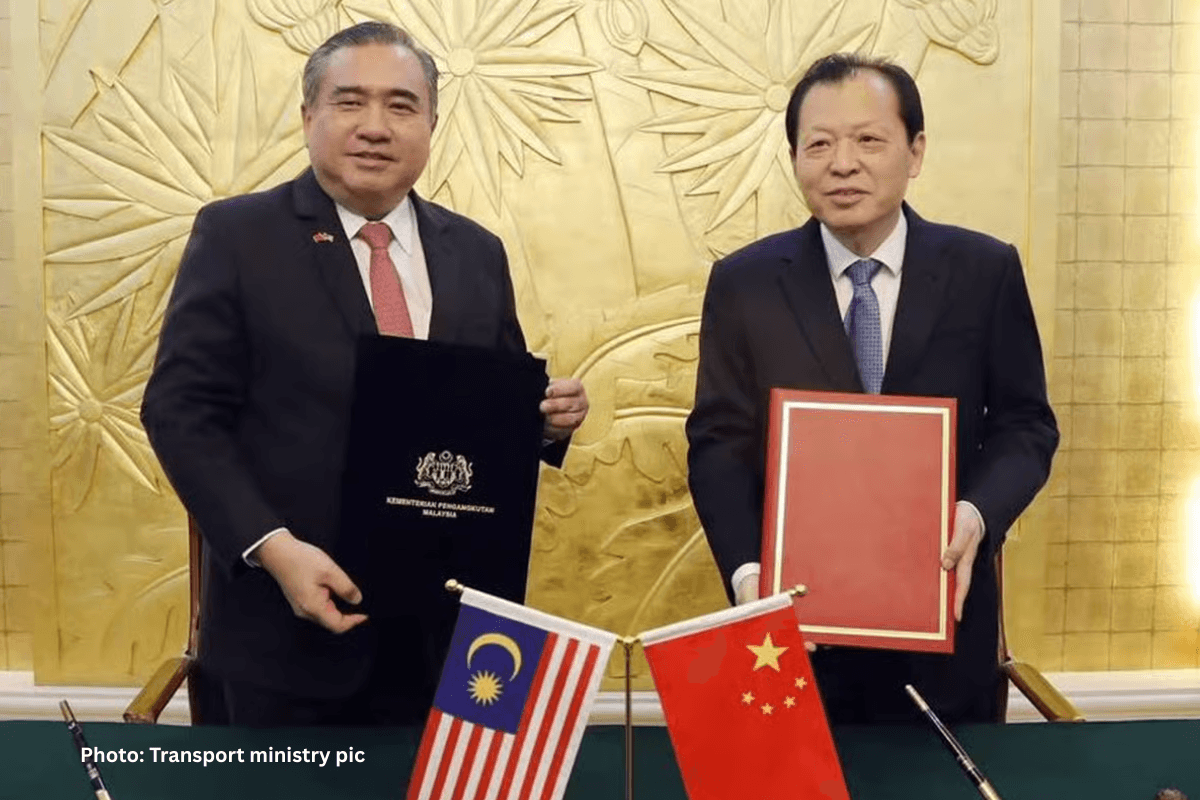
Malaysia, September 2026 — Malaysia and China have formalised a new framework for transport cooperation following a bilateral meeting between Malaysian Transport Minister Anthony Loke and Chinese Transport Minister Liu Wei during Loke’s official visit to Beijing. The agreement covers land, rail, maritime and air transport, as well as logistics.
For the rail sector, the cooperation includes exchanges on technical expertise, capacity building, operational safety, regulation and the application of technology in rail systems. Loke also held discussions with Song Xiude, administrator of China’s National Railway Administration, covering rail development and regulation, safety, workforce development and technology.
The wider framework also identifies artificial intelligence, green transport and low-carbon infrastructure as areas for cooperation. According to Malaysia’s Ministry of Transport, the collaboration is intended to strengthen transport connectivity and efficiency while supporting the development of more sustainable systems in both countries.
The agreement forms part of broader Malaysia-China transport engagement, with Malaysia seeking to strengthen policymaking capabilities, improve supply-chain efficiency and attract technology investment. For rail stakeholders, the framework could provide channels for greater knowledge exchange and technical collaboration as Malaysia continues developing and modernising its rail infrastructure.
The cooperation also reflects the increasingly integrated role of technology, operational expertise and sustainability in rail development. By establishing a formal bilateral framework across multiple transport modes, Malaysia and China are creating a basis for continued cooperation in areas relevant to the future development and management of rail systems.
Source: Malay Mail
Malaysia And China Expand Strategic Cooperation Across Rail Transport

Journalism & Media
Share this story
Malaysia and China are strengthening transport-sector cooperation as both countries pursue greater connectivity, efficiency and sustainability across their transport networks. A new memorandum of understanding establishes a framework covering rail alongside land, maritime, air transport and logistics, with technology, skills and low-carbon infrastructure among the focus areas.